



By Kai Ioh and KE TEAM Hawaii
Kai Ioh is a luxury real estate advisor based in Kona, Hawai‘i, specializing in second home, resort, and ultra-high-net-worth markets across the Big Island.
Key Takeaways
-
This March Kailua-Kona market update shows a noticeable pickup in buyer activity across both single-family homes and condos as spring seasonality builds.
-
Pending sales improved in both segments, but price per square foot remains down year over year, suggesting values are adjusting, and buyers are negotiating.
-
Inventory is steady for single-family homes and tightened for condos after last month’s jump, pointing to a more stable balance than February.
-
Kona’s early-year median prices can swing due to small sample sizes and changing sales mix, so trend signals matter more than one headline number.
-
Geopolitical uncertainty is also part of buyer psychology. In Kona and other Hawai‘i resort markets, external shocks can slow decision-making even when local activity is improving.
Kailua-Kona market context: why spring activity can rise while pricing still adjusts
March data shows the Kona market becoming more active as we move into the spring selling season. Pending sales increased in both single-family homes and condos, which is consistent with the typical seasonal pattern that starts to build in February and March.
At the same time, headline median prices still need to be interpreted carefully. In early-year Kona markets, lower transaction volume can make the median move sharply from month to month even when the broader market is relatively stable. That is why the full picture matters.
What metrics matter most in this Kailua-Kona market update?
In Kona, the strongest market signals usually come from a combination of pending sales, inventory, months of supply, and price per square foot. Median price is useful, but it can be distorted by sales mix when volume is low.
This month, the consistent story across both segments is that demand improved, but price per square foot remains down year over year. That combination typically means buyers are active, but disciplined, and sellers still need to meet the market.
Kona single-family home market: March 2026
What happened to single-family prices in March?
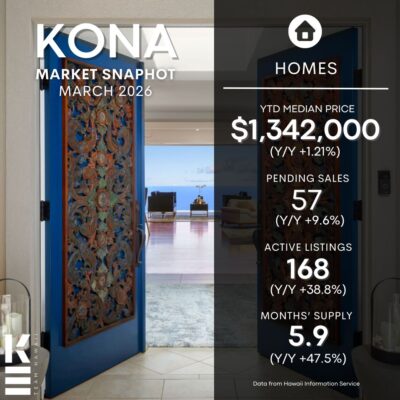
Kailua Kona March 2026 Real Estate Market Snapshot
The year-to-date median price for Kona single-family homes came in at $1,342,000, up 1.21% year over year. Month over month, the median declined from the elevated beginning of year level of $1.41M.
That drop looks dramatic at first glance, but it is not automatically a sign of weakening demand. In the first quarter, median prices can be pulled up or down by small sample sizes and shifting sales mix. This month’s move back toward the mid-$1.3M range looks like normalization.
Single-family supply and demand snapshot
March single-family activity improved:
-
Pending sales: 57 (up about 9.6% month over month and 9.6% year over year)
-
Active listings: 168 (essentially flat from 167 last month)
-
Months of supply: 5.9 months
-
Median days on market: 46 days
-
Median sold price per square foot: $703 (down 3.83% year over year)
Demand is improving into spring, but the pricing backdrop remains sensitive. In practical terms, buyers appear willing to act when the home is positioned correctly, but they are still pushing for value.
What is driving the single-family median right now?
The strongest movement appears to be in the under $1M range, where pending sales jumped significantly. More closings in that lower-priced band can pull the median down even as overall demand improves.
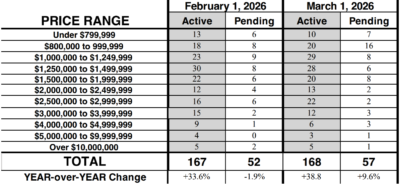
At the same time, Kona is not moving uniformly. The $2M to $3M range appears to be slowing, while the $3M to $5M segment has picked up again. This is a reminder that Kona behaves more like a set of micro-markets than one market.
What do the supply numbers really mean for single-family homes?
At 5.9 months of supply, the single-family market reads as balanced to slightly buyer-leaning overall. However, market balance depends heavily on the price range.
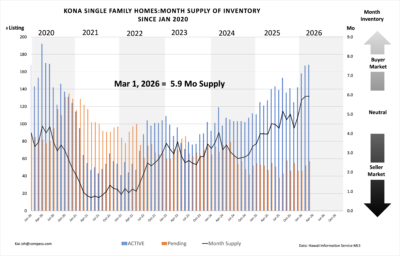
Kona Single Family Home Months Supply- March 2026
One of the weaker areas is the $2.5M to $2.9M range, where the active-to-pending ratio is around 11:1. That suggests limited urgency in that segment relative to available inventory, often leading to longer timelines and more negotiation.
Forward-looking single-family indicators
Two forward-looking indicators stand out for the next reporting cycle.
1) Median price of current pending sales
The median price of current pending single-family sales that are in escrow is approximately $1.199M. Pending sales often close within 30 to 45 days, so this can act as a leading indicator for the next reported median. That number suggests the median could soften next month.
2) Price per square foot
The median sold price per square foot is down about 4% year over year. This matters because it can indicate that similarly sized homes are selling for less than they were a year ago, even when the headline median looks stable.
Kona condominium market: March 2026
What happened to condo prices in March?
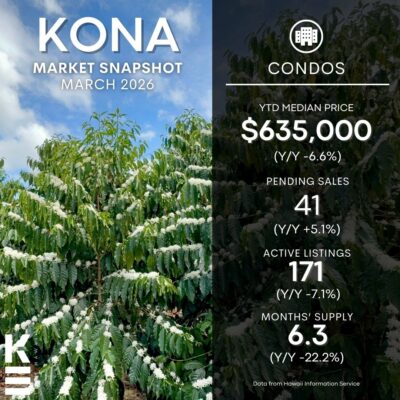
Kona Real Estate Market Snapshot- March 2026
The Kona condo year-to-date median price came in at $635,000, down 6.6% year over year. March showed a rebound from prior months, aligning with the idea that recent weakness was partly driven by a concentration of lower-priced sales.
This month’s move back toward the mid-$600Ks supports the view that earlier softness was at least partly compositional. Even so, the year-over-year comparison still shows a lower pricing level than last year.
Condo supply and demand snapshot
March condo fundamentals improved:
-
Pending sales: 41 (up about 13.9% month over month and 5.1% year over year)
-
Active listings: 171 (down from 185 last month)
-
Months of supply: 6.3 months (down from about 6.9 months)
-
Median sold price per square foot: $652 (down 10.56% year over year)
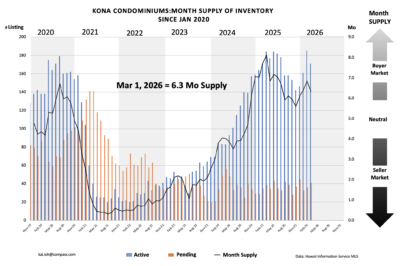
Kona Condo Months Supply – March 2026
After inventory jumped last month, the condo market tightened in March. The decline in listings and months of supply suggests a more stable balance than in February, even though values still appear to be adjusting.
Why the lower-end condo segment remains under pressure
Even with improving pending sales, the lower end of the condo market continues to face affordability pressure. In Kona, the total cost of ownership can weigh heavily on condo buyers, especially in more financing-sensitive segments.
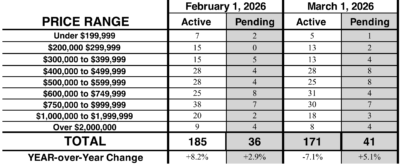
Kona Condo latest market update by price range
Key factors commonly include rising AOAO fees, higher property taxes, higher mortgage rates, and ongoing buyer sensitivity around insurance and carrying costs. When these costs rise faster than incomes or rents, buyers tend to become more selective and negotiate harder.
Forward-looking condo indicator
Pending sales have improved following price adjustments, but the pricing trend remains soft. That means condo median prices may dip again next month even if demand remains healthy.
Price per square foot remains one of the clearest signals. With condo PPSF down materially year over year, it suggests values are still adjusting, particularly for units where ownership costs are most visible to buyers.
Mortgage rate update
The average 30-year fixed mortgage rate was approximately 6.07% in early March, down slightly from 6.15% about a month earlier. The mortgage rate moved upwards after the war broke out in the Middle East.
That modest improvement is not enough to transform affordability, but it can support spring activity at the margin. In Kona, financing conditions often matter most in the low to mid-range and condo segments, where payment sensitivity tends to be higher.
How geopolitical uncertainty can influence Kona real estate
Beyond local supply and mortgage rates, geopolitical uncertainty can affect buyer confidence in Hawai‘i. In these markets, uncertainty often shows up first as slower decision-making, longer due diligence, and more negotiation, rather than an immediate collapse in activity.
In 2025, tariff uncertainty under President Trump was a noticeable confidence headwind locally. In my view, it contributed to a “pause” dynamic, where some buyers waited for a clearer economic direction before committing. That kind of hesitation can matter in small markets like Kona.
Regardless of how events unfold, moments like this can heighten broader uncertainty, often making discretionary buyers more cautious.
What March 2026 data really tells us about the Kona market
March shows a market that is gaining momentum, but still very price-sensitive.
Single-family homes are seeing stronger pending activity, but the mix of what is selling, especially more action under $1M, could place downward pressure on next month’s median. Higher-end activity seems to regain momentum.
Condos are also seeing improved demand, and inventory tightened after last month’s jump. That is a constructive sign. However, affordability pressures and weaker price per square foot suggest that condo values are still adjusting beneath the surface.
Looking ahead: spring 2026 in Kailua-Kona
As we move deeper into spring:
-
Single-family median pricing may soften next month due to the lower pending-sales median and increased lower-end activity.
-
Condos appear more stable than last month, but prices could still soften because affordability remains a constraint.
-
Price per square foot will remain one of the most important metrics to watch in both segments.
-
Inventory suggests Kona is balanced to slightly buyer-leaning overall, depending on property type and price range.
In short, the market is flat, but not going down. Momentum is improving, yet buyers are still watching value closely, and geopolitical uncertainty can add friction to decision-making even when local metrics look healthier.
For the latest Big Island real estate data, please access our latest Market Data Flipbook.
Kai Ioh, KE Team Hawaii
Frequently Asked Questions
What does the March 2026 Kailua-Kona market update show?
It shows rising spring activity in both single-family homes and condos, with higher pending sales in both segments. At the same time, price per square foot remains down year over year, which suggests values are still adjusting.
Why can Kona median prices swing so much early in the year?
Kona transaction volume is often lower in the first quarter, so the sales mix can move the median more than it would in a larger mainland market. A few more closings under $1M or above $3M can change the median even if overall demand is steady.
Is Kailua-Kona a buyer’s market right now?
Overall, the single-family segment looks balanced to slightly buyer-leaning at about 5.9 months of supply. Condos are also on the buyer-leaning side at about 6.3 months. However, conditions vary widely by price band and property type.
Why does price per square foot matter so much in Kona?
Price per square foot helps measure underlying value trends. In March, it declined year over year in both single-family homes and condos, which suggests buyers are still negotiating and that values may be softening even when the median price looks stable.
What is the clearest signal for where next month’s median might go?
One of the clearest signals is the median of current pending sales. For single-family homes, the pending-sales median is about $1.199M, and pending transactions often close within 30 to 45 days. That can foreshadow a softer reported median.
Why are Kona condos still under pressure at the lower end?
The lower end of the condo market is more sensitive to total ownership cost. Rising AOAO fees, higher property taxes, and insurance and carrying-cost concerns can reduce affordability and increase buyer caution, even when demand is improving.
Does higher pending sales automatically mean prices will rise?
Not necessarily. Pending sales can rise because buyers are responding to better pricing and more negotiable conditions. When price per square foot is still down year over year, it often signals that activity is improving before values fully stabilize.
How can geopolitical uncertainty affect Kona real estate?
In Kona and other Hawai‘i resort markets, uncertainty often slows discretionary decisions. Buyers may pause, extend due diligence, or negotiate harder. This tends to appear first as longer timelines and more selective demand rather than a sudden drop in listings or closings.
What happened in 2025 with tariffs and the local market?
In 2025, tariff uncertainty under President Trump coincided with a slower, more cautious market locally. In Kona, confidence shifts like this can stall decisions because many purchases are discretionary and sensitive to broader economic signals.
What is the main takeaway for sellers in March 2026?
Homes that are well-priced and well-positioned are moving, but buyers remain selective. Relying only on headline median prices can be misleading. In this environment, price per square foot, pending trends, and segment-by-segment behavior are the better guide.