



Why Median Prices Mislead in Early-Year Big Island Markets
By Kai Ioh and KE TEAM Hawaii
Kai Ioh is a luxury real estate advisor based in Kona, Hawai‘i, specializing in resort and ultra-high-net-worth markets across the Big Island.
Key Takeaways
-
The February 2026 median prices in Kailua-Kona were heavily influenced by the sales mix, not by a sudden shift in demand.
-
A small number of luxury single-family closings pushed the median higher, while entry-level condo sales pulled condo medians down.
-
Pending sales and months of supply point to a neutral, balanced Kona market rather than acceleration or decline.
-
Forward-looking indicators suggest single-family prices may normalize, while condos appear positioned to rebound as spring activity builds.
Kailua-Kona Real Estate Market Context: Why Early-year Data Requires Caution
Early-year market data in Kona often comes with smaller sample sizes. In markets like the Big Island of Hawai‘i, where luxury and entry-level transactions can vary sharply month to month, a handful of closings can distort headline medians.
This month, based on January 2026 data is a clear example. While top-line numbers suggest dramatic price movement, a deeper review of composition, inventory, and pending sales shows a far more stable picture.
Kona Single-Family Home Market – February 2026
Median Price Surge: What Actually Happened

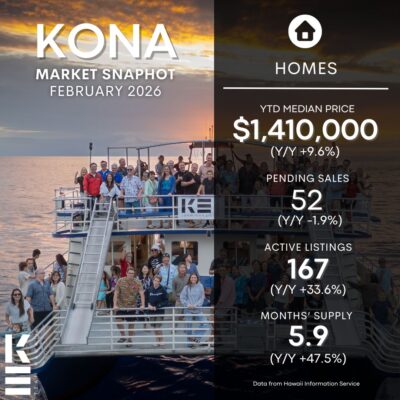
Kailua Kona Real Estate Home Market Snapshot February 2026
The median single-family home price rose 9.6% year-over-year to approximately $1.41M and increased 13% from December 2025. On the surface, this appears significant.
However, January had only 25 closings, including five luxury and ultra-luxury closings that disproportionately influenced the median. In a low-transaction month, these sales alone shifted the midpoint upward.
When those transactions are removed, the median falls back into the high-$1.1M range, consistent with recent months. This was composition-driven, not trend-driven.
Single-Family Supply and Demand Snapshot
-
Closed sales: Down 36% year-over-year
-
Active listings: 167 homes, up 5.6% month-over-month
-
Pending sales: 48 homes, up 13% month-over-month, down 2% year-over-year
-
Months of supply: 5.9 months, up 47.5% year-over-year. This means the pace of sales is slower.
A 4–6 month supply typically defines a neutral market, placing Kona in the upper threshold of balanced territory.

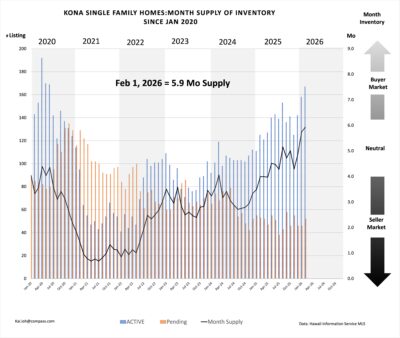
Kona Single Family Home Months Supply Feb 2026
Forward-Looking Single-Family Price Indicator
While the sharp increase in the reported median price may sound encouraging for sellers, it does not fully align with the broader market context. Nationally, Kona’s primary feeder markets remain largely flat, certainly not showing signs of 10% month-over-month appreciation. At the same time, supply is rising, price per square foot is trending lower, and buyer demand has softened.
To look ahead, we used pending sales data as a forward-looking indicator to estimate where the median price is likely to settle in the near term.
Pending sales are a forward-looking indicator in the Kona market because most close within 30–45 days, thereby largely determining where median prices will be reported next.
Current single-family pending sales in Kona: 48
Average adjustment: –2.8% (2025 median discount rate)
Projected median based on pending sales: approximately $1.3M
This points to modest short-term softening and reinforces that the recent higher median was driven by a small number of luxury closings, rather than broad-based price momentum. Unless pending sales close way above asking – which would be unrealisitc in the current environment, the median price next month is more likely to return to the $1.3M to $1.35M range. That would still represent a positive but more stable trend relative to December 2025, when the median stood at $1.25M.
Kona Condominium Market – February 2026
Why Condo Prices Fell on Paper

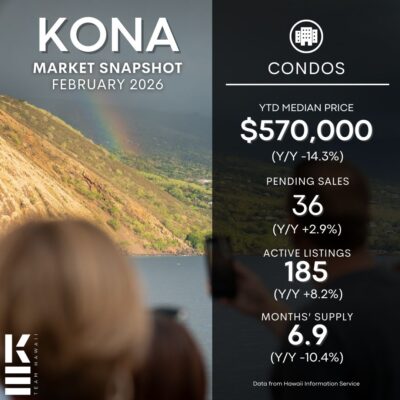
Kailua Kona Condominium Market Snapshot Feb 2026
The condo median declined 14.3% year over year to $570,000, and fell 7.3% month over month. The reason of significant decline may not be a weakening demand.
January condo closings were concentrated in the $400K–$500K range, while higher-priced units simply did not. We will know more as the year progresses if this is a real trend in 2026.
Condo Market Fundamentals
-
Closed sales: Down 12% year-over-year
-
Active listings: Up 8% year-over-year and 15% month-over-month
-
Pending sales: Up both year-over-year and month-over-month
-
Months of supply: 6.9 months, 10% decline YoY
Seasonally, condo inventory in Kailua-Kona often builds through March before tightening.

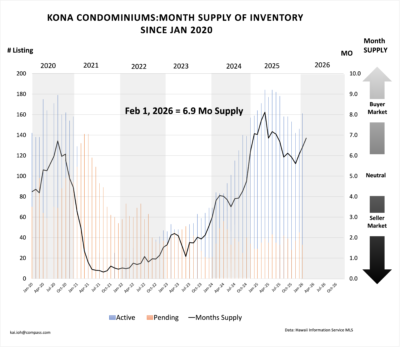
Kona Condominium Month Supply Feb 2026
Forward-Looking Condo Median
Let’s adjust this using pending sales data:
-
Current Pending Condo sales: 39
-
Typical adjustment: 2.3% (2025 median)
-
Projected median with Pending Sales: approximately $633K
This suggests a potential rebound from January’s reported median, confirming that the significant dip was compositional.
What February 2026 Data Really Tells Us About the Kona Market
February highlights a common early-year pattern in Big Island real estate:
-
Single-family medians rose due to luxury-weighted closings
-
Condo medians fell due to entry-level sales concentration
-
Underlying demand remained steady across both segments
Inventory growth has been modest, buyer activity continues, and the market remains balanced, not overheated or distressed.
Looking Ahead: Spring 2026 in Kailua-Kona
As transaction volume typically increases through Q1:
-
Single-family pricing is likely to settle in the $1.3M to $1.35M range (2025 Dec Median: $1.25M)
-
Condo pricing appears positioned to stabilize in the low-$600Ks (2025 Dec Median: $610,000)
In Kona and across the Kohala Coast, forward indicators—pending sales, inventory, price per sqft, and supply—offer more reliable guidance than headline medians during low-volume months. We need about 100 sold data points to effectively see the trend.
For more data and analysis, see our monthly Big Island Market Update Flipbook
Kai Ioh, www.KETeamHawaii.com
Frequently Asked Questions
Why do Kona median prices fluctuate so much early in the year?
Lower transaction counts in January and February mean that a few luxury or entry-level sales can disproportionately affect the median.
Does a higher median price mean the Kona market is heating up?
Not necessarily. In early-year data, median increases often reflect sales mix rather than broad price appreciation.
What is a neutral market in Kailua-Kona?
A market with roughly 4–6 months of supply, where neither buyers nor sellers have a strong advantage.
Are condos in Kailua-Kona declining in value?
Current data suggests the recent drop was compositional. Pending sales point to price stabilization rather than decline.
Why are pending sales important in Kona real estate analysis?
Pending sales reflect current buyer behavior and often provide a clearer view of near-term pricing than closed sales alone.
How does the Kona market differ from mainland markets?
Kona has a higher share of second homes and luxury properties, making medians more sensitive to sales composition.
Is inventory rising in Kailua-Kona?
Yes, modestly. Inventory growth has contributed to a more balanced market environment.
Should buyers or sellers focus on median prices?
Median prices should be viewed in context. Inventory, pending sales, and supply offer a more complete picture.